

Hearing the Will of the People in the Vote: The Mathematics of Redistricting
2026 Department of Mathematics Daniel Bartlett Memorial Lecture led by Jonathan Mattingly of Duke University.
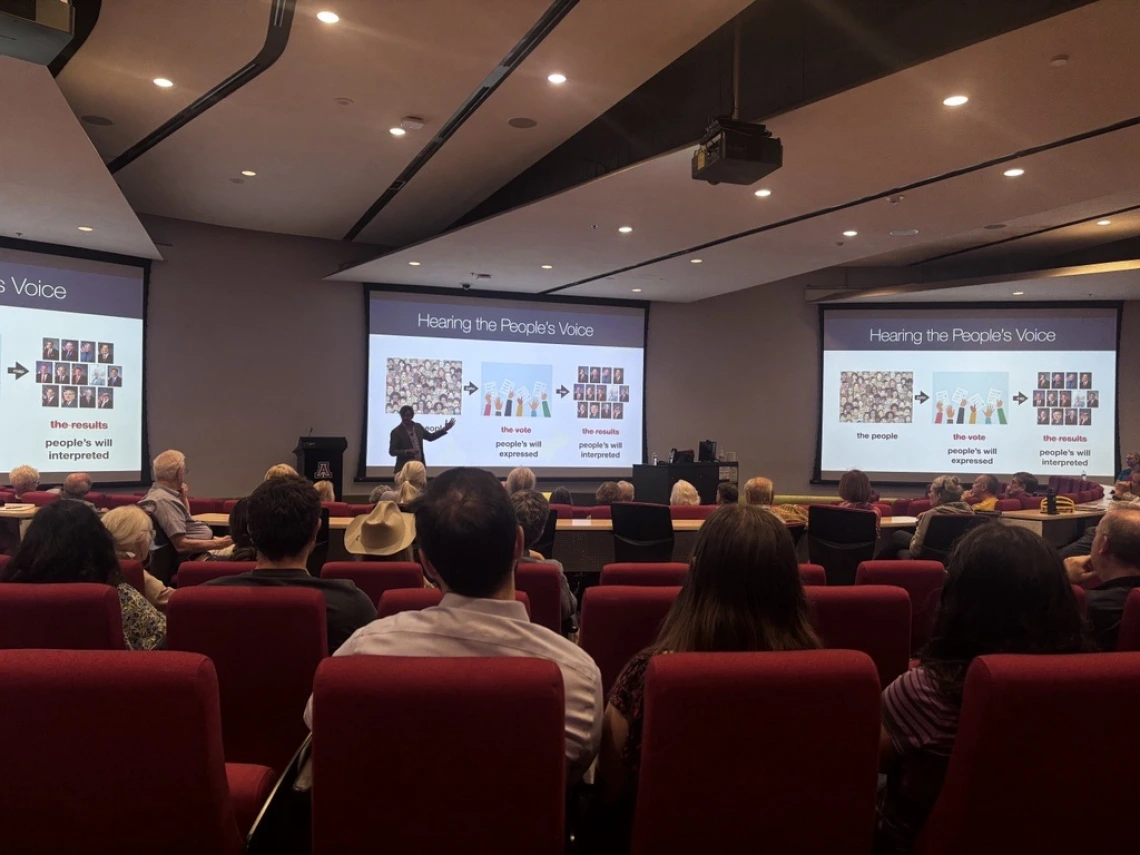
Recently, the Department of Mathematics at the University of Arizona hosted another successful Daniel Bartlett Memorial Lecture. The lecture is designed to give the general public a window into the nature of mathematics by illustrating the work of renowned mathematicians. This year, the department welcomed Jonathan Mattingly, a leading mathematician known for blending theory with real-world impact.
After graduating from the NC School of Science and Mathematics, Mattingly earned a BS in Applied Mathematics from Yale and a PhD in Applied and Computational Mathematics from Princeton under Yakov Sinai. His academic journey included a Rotary Fellowship in France and positions at Stanford and the Institute for Advanced Study before joining Duke University in 2003. Today, he holds the titles of James B. Duke Professor of Mathematics and Kimberly J. Jenkins Distinguished University Professor of New Technologies. Mattingly’s research explores the long-term behavior of random dynamical systems and stochastic partial differential equations, with landmark contributions to the ergodic theory of fluid dynamics. His work spans numerical methods, biological systems, and even influenza evolution.
Beyond academia, he’s a national voice on fair elections, providing expert testimony in major redistricting cases. Honors include an NSF CAREER Award, PECASE, Sloan Fellowship, and election as Fellow of IMS and AMS. In 2019, Common Cause recognized him with the Defender of Freedom Award for his fight against gerrymandering.

Audience members gathered in ENR2 to learn more about Mattingly’s work with the “Quantifying Gerrymandering” team at Duke University, which includes faculty and students. Gerrymandering is the practice of manipulating electoral district boundaries to give a political party an advantage in an election. The goal of the lecture was to help the audience understand and identify gerrymandering in order to be more informed in future elections. He stressed that the talk was not about parties but rather the people voting and how to keep elections fair, keeping his research “intentionally neutral”.
What’s most important in a democracy is that the will of the people is heard. The votes are the people’s will expressed and the results are actually how that will is interpreted. A “fair” map should reflect the will of the people.
Previously, the question was “does gerrymandering exist?” Over the last 10 or so years, mathematicians everywhere have been bringing gerrymandering to light. Now, the question being asked is “what should we expect from the system that we have?”
Mattingly spoke of court cases that he worked on in North Carolina after being selected based on research paper from his past. He noted that it took a while for lawyers to listen. No matter how the maps were changed or manipulated, the same outcome occurred for both parties. The question became, “how do we choose the right map?” This is where math comes into the picture.
Via statistical methods that compare a map to an ensemble of thousands of possible maps, if the results indicate a noticeable difference between seats for one party over the other, then most likely, gerrymandering is taking place. He took the audience on a journey through his research and the models he is working on. Currently, him and his team are able to run simulations that are used as evidence in redistricting cases. However, in most cases, the simulations generate even more questions, creating more complex mathematics. The math is explained well in this article in Quanta Magazine.
“What we want is at any given moment, a number of representatives in danger of losing their seats,” Mattingly said. At the end of the day, what’s most important is the responsiveness of elections.
“Elections should have consequences. As the people’s opinions shift, so would the elected representatives,” Mattingly shared. He also noted that it is important to remain informed when looking at these new mathematical models that are being developed. Just because math is presented, doesn’t mean it is sound. Bringing us back to the main topic of the talk itself, being informed as a people so our voice and will are heard.